
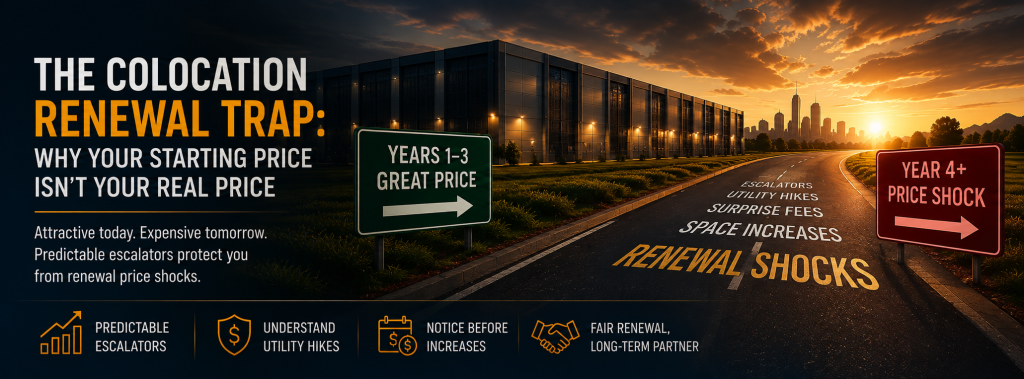
Why an inexpensive initial colocation contract can become extremely expensive after your equipment is installed—and why predictable escalators matter.
A data center offers an attractive price.
You move in.
You install cabinets, servers, switches, routers, storage systems and cabling. You order cross-connects and carrier circuits. You configure redundancy, monitoring and remote access.
A few years pass.
Then your contract comes up for renewal.
Suddenly, the economics can look very different. An aggressive “REIT” data center hikes your contact by 30%
This is why customers shouldn’t evaluate colocation based solely on the price appearing on the first month’s invoice.
The real question is what your infrastructure will cost over the entire time you expect to remain in the facility.
Once You’re Installed, Moving Isn’t Easy
Colocation creates substantial switching costs.
Moving isn’t equivalent to changing an online subscription.
Physical equipment has to be unracked, transported and installed somewhere else.
Replacement network circuits may have to be ordered.
Cross-connects need to be recreated.
IP connectivity may have to be changed.
Remote-access procedures, monitoring, access lists and redundancy plans may need to be rebuilt.
Customers may need to operate both facilities simultaneously during the migration.
There can be engineering labor, transportation costs, installation fees and downtime risks.
For a substantial deployment, relocation can become a major infrastructure project.
That means the customer negotiating its original contract and the customer negotiating its renewal are not necessarily negotiating from the same position.
The Cheap Initial Price Can Be Misleading
Imagine two providers.
Provider A offers an extremely attractive initial price but provides little long-term pricing certainty.
Provider B starts slightly higher but provides a predictable annual escalator.
Provider A wins the Year-One spreadsheet.
But what happens in Year Four?
Year Six?
Year Ten?
Some customers discover at renewal that the inexpensive introductory economics no longer exist.
Power can increase.
Space can increase.
Cabinet or cage charges can increase.
Ancillary services can increase.
A customer may suddenly face a 20%, 30% or other substantial increase and discover that moving the infrastructure costs even more.
A cheap introductory rate therefore doesn’t necessarily represent a cheap long-term data center.
The Difference Between a Predictable Escalator and a Price Shock
There is nothing inherently unreasonable about data center prices increasing.
Electricity becomes more expensive.
Labor costs change.
Insurance changes.
Property expenses rise.
Utilities receive approval for new tariffs and rate schedules.
The question isn’t whether prices can ever increase.
The question is:
Can the customer predict and understand those increases?
At Metanet, our philosophy is to use predictable annual escalators rather than treating the end of a contract term as an opportunity for dramatic repricing.
Depending upon the geographic market and anticipated underlying cost environment, an annual escalator might typically be approximately 3% to 5%.
Where utility costs are an important driver, customers should be able to understand the underlying utility changes and review the applicable utility or regulatory information themselves.
We provide notice of anticipated increases.
The objective isn’t to pretend infrastructure costs never rise.
The objective is predictability.
Utility Increases Should Be Understandable
Utilities such as Con Edison and other regional power companies generally operate under regulatory structures in which rate changes and approved increases are publicly documented.
That creates an external reference point.
If underlying electricity costs are expected to rise, customers should be able to understand that those costs are changing.
A predictable escalation related to real changes in the cost environment is fundamentally different from reaching the end of a contract and discovering an unexplained large increase simply because the existing term expired.
Customers should be able to ask:
What changed?
Why did my price increase?
What external costs contributed to it?
What should I expect next year?
Predictability Has Financial Value
Consider a $10,000 monthly deployment with a 4% annual escalator:
Year 1: $10,000/month
Year 2: $10,400/month
Year 3: $10,816/month
Year 4: $11,249/month
Year 5: $11,699/month
The bill increases.
But there is an enormous difference between an increase and a surprise.
The customer can model those numbers before deploying its infrastructure.
It can price its own products appropriately.
It can create budgets.
It can forecast margins.
It can decide whether the economics make sense over five or ten years.
Compare that with a $10,000 monthly contract that suddenly becomes $12,000 or $13,000 at renewal.
Now the customer has a problem.
The Renewal Leverage Problem
By the time renewal arrives, the provider knows something it didn’t know during the original sales process:
Leaving may be extremely difficult for you.
Your equipment is already installed.
Your circuits are working.
Your cross-connects are established.
Your customers may depend on the infrastructure.
Your engineers know the facility.
Relocating may require months of planning.
That creates economic leverage.
A customer might conclude that paying an additional $2,000 or $3,000 per month is painful but still temporarily cheaper than spending tens of thousands of dollars and assuming operational risk to migrate.
That is why renewal methodology should be considered before the first server enters the building.
Power Isn’t the Only Thing That Can Increase
Customers also need to examine the underlying cabinet, cage, space or license charges.
A data center may say that increased power density or operating costs require adjustments elsewhere in the pricing structure.
The result can be substantial increases not only to electricity but to the space itself.
Customers should therefore determine how the provider can increase:
Power
Cabinet charges
Cage or space charges
Cross-connects
Remote hands
Ancillary services
Other recurring fees
and:
The renewal rate itself
A low initial power price means very little if other components can be substantially repriced later.
Our Philosophy After Approximately 30 Years
Metanet has been operating telecommunications and infrastructure services for approximately 30 years.
We have not built our business around dramatically repricing customers simply because their equipment has become difficult to move.
Normal increases occur.
Utilities increase rates.
Operating costs change.
Those costs eventually have to be reflected in pricing.
But we believe changes should be reasonable, communicated and predictable.
When a customer’s term ends, our objective is to continue the relationship using the same general pricing philosophy—not to treat the customer’s installed infrastructure as an opportunity for an enormous renewal increase.
We want long-term customers.
And long-term relationships require customers to trust that renewal isn’t going to become a pricing ambush.
Ask About Year Five Before Signing Year One
Before choosing a data center, ask:
What is the annual escalator?
What does it apply to?
Is the escalator fixed or variable?
How are utility increases handled?
Can I independently verify the underlying utility changes?
How much advance notice will I receive?
What happens when my initial term expires?
Can power and space be repriced separately?
Does renewal continue the established pricing methodology?
Can the provider move me to then-current market rates?
And perhaps most importantly:
If I remain here for five or ten years, can I reasonably predict what I’m going to pay?
The cheapest data center on installation day isn’t necessarily the cheapest data center five years later.
For infrastructure that is expensive and disruptive to relocate:
Predictable pricing is part of the product.