
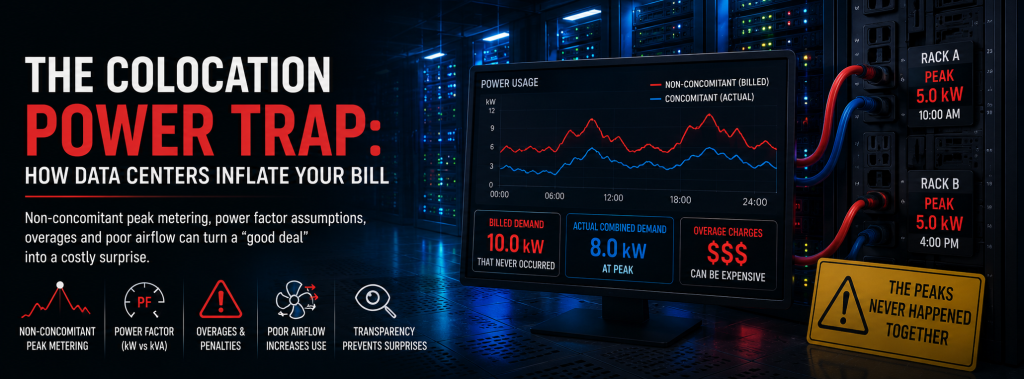
How a price per kilowatt that looks like a “great deal” can turn into a far more expensive bill through various schemes that many data centers use, such as: non-concomitant peak metering, power-factor assumptions, overage penalties and even poor airflow.
When customers compare data centers, one of the first questions they ask is:
What is your price per kilowatt?
It sounds like a straightforward way to compare providers.
It isn’t.
A data center can advertise a substantially lower price per kilowatt and still ultimately charge FAR more for power because the advertised rate tells you only half of the equation.
The other half is:
How does the data center determine how many kilowatts it is going to bill you for?
This is particularly important with metered or on-demand power.
One of the least understood differences is between measuring the customer’s concomitant—or simultaneous—aggregate demand and adding together non-concomitant—or non-simultaneous—individual circuit peaks.
Those two methods can produce dramatically different results from exactly the same equipment.
And most customers don’t know to ask about the difference.
How Power Is Distributed in a Data Center
Imagine a customer with a cage or row containing multiple cabinets.
Each cabinet may contain multiple rack PDUs or power strips. Those devices are supplied by branch circuits that ultimately connect to upstream PDUs and other electrical distribution equipment.
For redundancy, servers commonly have dual power supplies.
One may connect to the A electrical path while the other connects to the B path.
A larger deployment can therefore have dozens of separately monitored circuits distributed across multiple cabinets and redundant electrical systems.
That creates a critical billing question:
Does the provider calculate your total demand by looking at what all of those circuits were drawing at the same time?
Or does it find the highest reading reached by each individual circuit at potentially different times—and perhaps even on different days—and then add all of those peaks together?
Those are very different calculations.
Concomitant vs. Non-Concomitant Power
The distinction is easiest to understand with two racks.
At 10:00 AM:
Rack A: 4 kW
Rack B: 2 kW
Actual combined demand: 6 kW
Later, at 4:00 PM:
Rack A: 2 kW
Rack B: 4 kW
Actual combined demand: 6 kW
At no point did the customer’s equipment draw more than 6 kW simultaneously.
A concomitant—or simultaneous—measurement recognizes that.
But a non-concomitant calculation can look at the individual circuit peaks:
Rack A peak: 4 kW at 10:00 AM
Rack B peak: 4 kW at 4:00 PM
and calculate:
4 kW + 4 kW = 8 kW
The customer is now treated as having 8 kW of demand even though the deployment never actually drew 8 kW at one time. Then the data center will bill the customer a huge penalty in the thousands of dollars for ‘using 8kW’ power for the month, at a high penalty per KW cost. And worst of all this peak could have happened during an hour window then the customer will be hit for an entire month of 8kW power even though the power peaked merely for a short period of time just once.
The additional 2 kW exists because of the measurement methodology.
This distinction becomes increasingly important as the number of cabinets and circuits increases.
It Can Get Worse When Peaks Come From Different Days
Imagine a cage with many cabinets whose workloads fluctuate.
Rack A may reach its monthly high on Monday.
Rack B reaches its high on Thursday.
Rack C peaks two weeks later.
Rack D peaks near the end of the month.
If those independent maximums are retained and aggregated, the resulting billing number can represent a theoretical combination of loads that never existed together at any moment during the month.
That can trigger substantial overage charges.
A customer looking only at its monthly invoice may have no idea this occurred.
The Server-Move Problem
A simple equipment move demonstrates the problem even more clearly.
Suppose a server consuming approximately 1 kW is installed in Rack A.
Later in the month, the server is physically moved from Rack A to Rack B.
After the move:
Rack A decreases approximately 1 kW.
Rack B increases approximately 1 kW.
Nothing was added to the deployment.
The customer still owns exactly the same equipment.
Total demand hasn’t increased because of the move.
The same 1 kW load simply changed locations.
But consider what can happen when individual monthly peaks are retained.
| Measurement | Rack A | Rack B | Actual Combined Load |
|---|---|---|---|
| Before server move | 5 kW | 3 kW | 8 kW |
| After server move | 4 kW | 4 kW | 8 kW |
| Individual monthly peaks | 5 kW | 4 kW | — |
The provider can aggregate:
5 kW + 4 kW = 9 kW
But the customer’s actual combined demand never exceeded:
8 kW
In effect, the same server contributed to Rack A’s earlier peak and Rack B’s later peak.
There was never a second server.
There was never an additional 1 kW of simultaneous demand.
Yet the billing calculation can make it appear that there was.
Multiply that effect across many racks, equipment migrations, changing workloads and dozens of circuits, and the discrepancy can become significant.
Why Data Centers Defend This Practice
A data center may respond:
“We still have to provide the upstream capacity.”
There is a legitimate engineering argument behind that statement.
Breakers, conductors, PDUs, UPS systems, generators and other upstream electrical infrastructure have to be engineered to safely support potential loads.
If a circuit is provisioned for a certain capacity, the facility has to account for it.
But that introduces an important distinction:
Reserved capacity is not the same thing as measured simultaneous demand.
A provider can legitimately sell:
“10 kW of reserved electrical capacity.”
But that is different from saying:
“Your equipment reached 10 kW of actual combined demand.”
Those are two different products and two different measurements.
If customers are purchasing reserved capacity, the contract should say so.
If customers are paying usage-based overages, they should understand precisely how usage is being calculated.
Average, Peak and 95th Percentile Are Different Measurements
Customers also need to understand several other terms.
Average power represents consumption averaged over a period.
Peak demand generally identifies the highest measured demand during a defined measurement interval.
95th-percentile measurement takes measurements throughout a billing period, orders them and excludes the highest 5 percent when determining the percentile level. This can prevent a handful of brief excursions from determining the entire month’s billing level.
Non-concomitant peak aggregation can instead combine the maximum values of multiple circuits even though those maximums occurred at different times.
These methods are not interchangeable.
The same servers can produce different billable quantities depending entirely upon which methodology the contract specifies.
Then Come the Overage Penalties
The problem becomes even more significant when the contract has an expensive overage rate.
A customer might negotiate an attractive base price per kilowatt only to discover that usage above the commitment is billed at a substantially higher rate.
If the provider’s measurement methodology itself creates a higher billable peak, that methodology can become the trigger for the overage.
A customer may therefore face two separate effects:
First, the methodology increases the number of billable kilowatts.
Second, those additional kilowatts may be charged at an overage rate considerably higher than the ordinary rate.
A seemingly inexpensive power contract can therefore become much more expensive than expected.
The Power-Factor Problem: Are You Buying kW or kVA?
Another frequently overlooked issue is power factor.
Customers usually think about kilowatts (kW) because that represents real power consumed by equipment.
Electrical infrastructure must also account for apparent power, measured in kilovolt-amperes or kVA.
The relationship is:
Power factor = kW ÷ kVA
Therefore:
kVA = kW ÷ power factor
At a power factor of 1.0:
10 kW ÷ 1.0 = 10 kVA
At a power factor of 0.9:
10 kW ÷ 0.9 = approximately 11.1 kVA
The servers are still consuming 10 kW of real power.
But the apparent electrical capacity associated with that load is approximately 11.1 kVA at a 0.9 power factor.
Power factor is a legitimate electrical-engineering consideration.
The billing question is whether the provider is charging based upon measured real power, apparent power, or a conversion using an assumed power factor.
Customers should ask:
Am I being billed in kW or kVA?
Is power factor actually measured?
Or does the contract simply assume 0.9, 1.0 or another value?
Without knowing that, two advertised “$/kW” offers may not actually represent equivalent pricing.
Another Hidden Power Drain: Poor Airflow
There is another cost customers may never associate with their power bill:
the thermal environment surrounding their cabinets.
Servers don’t consume power independently of temperature.
Modern servers contain temperature-controlled fans. As server inlet and internal temperatures rise, those fans can increase speed to maintain safe operating temperatures.
Higher fan speeds consume additional electricity.
Poor cabinet airflow, obstructed exhaust, inadequate blanking, poor cable management or hot-air recirculation can create hot spots around particular cabinets even when the overall room temperature appears acceptable.
That means a customer’s electrical consumption can be affected by the environment in which its equipment is operating.
You Can Pay for Poor Cooling Twice
Suppose the customer hasn’t installed another server.
Its workload hasn’t materially changed.
Yet its electrical consumption rises.
If hot exhaust is recirculating toward server intakes, server fans may be working harder continuously.
Across one machine, that may be relatively small.
Across dozens or hundreds of servers operating 24 hours a day, it becomes another component of IT power consumption.
And there is a second-order effect.
Suppose the additional fan consumption pushes a deployment just above its contracted power threshold.
The customer isn’t merely paying for the extra electricity required by the fans.
The thermal inefficiency may now contribute to an overage.
If that overage is charged at a premium rate, a comparatively small increase in actual consumption can produce a disproportionately large increase in the bill.
In extreme thermal conditions, equipment may also throttle performance to protect itself.
So airflow isn’t merely a cooling issue.
It can affect power consumption, performance and ultimately cost.
Why Customers Often Don’t Know Any of This Is Happening
Most colocation customers are experts in servers, networking, storage, cloud infrastructure or software.
They aren’t electrical-metering specialists.
An invoice may simply say:
Measured demand: 14.2 kW
Power overage: X kW
But what exactly does 14.2 kW mean?
Was 14.2 kW actually drawn simultaneously?
Were individual peaks from different circuits added together?
Did those peaks occur hours apart?
Did they occur on different days?
Was it an average?
Was it a maximum interval?
Was it a 95th-percentile measurement?
Was power factor applied?
Was the underlying measurement actually kVA?
Was an overage multiplier then applied?
And was some portion of the increased electrical load caused by poor thermal conditions?
Unless the provider exposes the underlying data, the customer may have no practical way to know.
The Slow-Drip Problem
Not every inflated power cost arrives as one enormous charge.
Sometimes the difference is spread across circuits or months.
One cabinet generates an overage.
Another develops a higher peak.
A power-factor calculation adds a little more apparent capacity.
Poor airflow increases consumption slightly.
Each individual difference may not look significant enough to investigate.
But cumulatively, those differences can materially change the economics of a deployment.
That is particularly dangerous because the customer may attribute the rising expense to normal growth rather than to the billing methodology or operating environment.
By the time management realizes how much the effective price of power has increased, the infrastructure may already be deeply embedded in the facility.
Understanding the Metering Method Is Critical
Power measurement isn’t merely an engineering detail.
It is a financial term of your colocation agreement.
Knowing that power costs $300, $400 or $500 per kilowatt tells you very little unless you know how the provider determines the number of kilowatts appearing on the invoice.
Before signing, ask:
- Is my demand measured concomitantly—at the same measurement intervals?
- Can non-concomitant circuit peaks be added together?
- Can peaks from different days contribute to my billed demand?
- How are A and B feeds handled?
- What is the measurement interval?
- Is billing based on maximum, average, 95th percentile or another methodology?
- Am I being billed in kW or kVA?
- What power factor is used?
- Is power factor measured or assumed?
- How are overages calculated?
- Can a temporary peak permanently increase my commitment?
- Can I see the historical meter readings used to calculate my invoice?
- Will I receive alerts before exceeding my contracted power?
- Can I monitor power myself in real time?
- How does the facility monitor cabinet inlet temperatures and hot spots?
- How is hot-air recirculation controlled?
If the provider cannot clearly answer those questions, the advertised price per kilowatt doesn’t tell you what the service actually costs.
Why Metanet Gives Customers the Data
At Metanet, our philosophy is different.
We believe customers should be able to see their actual power consumption themselves.
Our customer control systems provide power monitoring and historical graphs so customers can see what their infrastructure is drawing.
Customers can identify spikes.
They can investigate a particular rack.
They can redistribute equipment.
They can balance circuits.
They can determine whether consumption is genuinely increasing.
And they can see when they’re approaching their contracted power allocation before an unexpected bill arrives.
Customers shouldn’t have to blindly trust a number appearing on an invoice.
They should be able to see the data behind it.
How We Handle Overages
If a customer genuinely exceeds its contracted power allocation, an applicable overage charge can occur.
But we distinguish between a temporary excursion and a genuine permanent increase in the customer’s operating requirements.
If a customer consistently operates above its contracted amount, then the contractual allocation should eventually increase to reflect the new level.
If the overage is transitory and subsequent measurements return to normal, we don’t believe one temporary event should automatically force the customer into an unnecessarily larger permanent commitment.
Our objective is to alert customers and give them an opportunity to investigate and adjust their infrastructure.
Maybe equipment needs to be redistributed.
Maybe a workload temporarily increased.
Maybe a server is malfunctioning.
Maybe airflow needs attention.
Or maybe the customer genuinely needs more power.
The customer should have enough visibility to understand the difference.
The Cheapest Kilowatt May Not Be the Cheapest Power
Suppose Data Center A advertises power at:
$350/kW
and Data Center B charges:
$400/kW
Data Center A appears cheaper.
But suppose Data Center A’s methodology produces 12 billable kW while Data Center B transparently measures 10 kW of actual aggregate demand.
The monthly calculation becomes:
$350 × 12 = $4,200
versus:
$400 × 10 = $4,000
The provider advertising the more expensive kilowatt actually produces the lower power bill.
Now add overage multipliers, power-factor treatment and the thermal efficiency of the environment.
Suddenly the advertised $/kW tells only a small part of the story.
Don’t Ask Only What a Kilowatt Costs
When evaluating colocation power, don’t ask only:
“What do you charge per kilowatt?”
Ask:
“How do you determine how many kilowatts you’re going to charge me for?”
At Metanet, our philosophy is straightforward:
The meter should be visible.
The calculation should be understandable.
The thermal environment should be properly managed.
Overages should reflect the agreed measurement methodology.
Customers should be warned when their consumption is increasing.
And customers should be able to verify the numbers themselves.
Because the true cost of data center power isn’t simply the advertised price per kilowatt.
It is the price per kilowatt multiplied by the number of kilowatts the data center decides to put on your bill.