
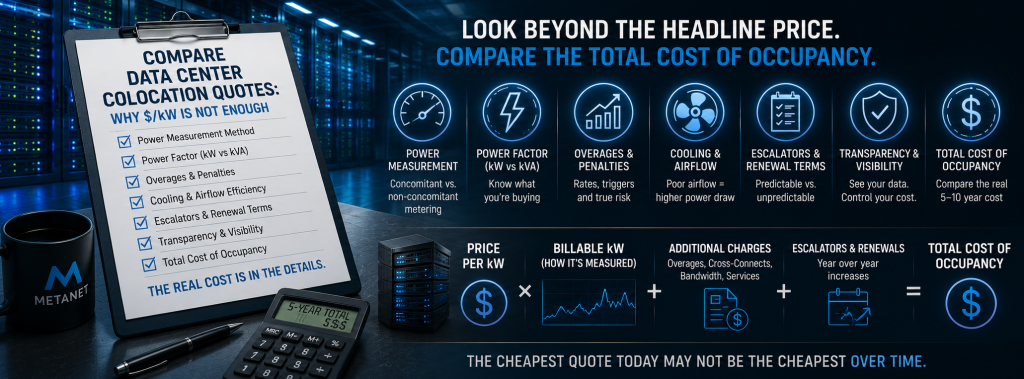
A practical guide to comparing the real long-term cost of colocation—including power measurement, overages, cooling, escalators, renewal pricing and the hidden cost of being unable to move.
Comparing colocation proposals looks easy.
Provider A charges $350 per kW.
Provider B charges $400.
Choose Provider A.
Unfortunately, that comparison may tell you almost nothing about which provider will actually cost less.
To properly compare colocation proposals, you need to answer several different questions:
How much does a kilowatt cost?
How does the provider determine how many kilowatts you’re billed for?
What happens when you exceed your commitment?
Is the facility helping your equipment operate efficiently?
What other recurring charges exist?
How will all of those prices change over time?
And what happens after you’re installed and no longer have the easy option of walking away?
Only after answering those questions can you compare the real cost of colocation.
1. Start With the Power Measurement
Don’t accept a quote that simply says:
“$X per kW.”
Ask what a billable kilowatt actually means.
Are all of your circuits measured during the same interval?
Or can the highest individual measurements from different circuits be added together even though they occurred at different times?
Can peaks from different days contribute to the same billed demand?
How are redundant A and B feeds treated?
Is billing based on:
Maximum demand?
Average demand?
95th percentile?
Reserved capacity?
Individual circuit peaks?
And can you see the underlying measurements yourself?
A cheap kilowatt isn’t cheap if the methodology produces more billable kilowatts.
2. Understand Concomitant vs. Non-Concomitant Demand
This deserves its own question in every serious colocation evaluation.
Suppose:
Rack A peaks at 5 kW on Monday.
Rack B peaks at 5 kW on Friday.
But when Rack A was at 5 kW, Rack B was drawing only 3 kW.
And when Rack B reached 5 kW, Rack A was drawing only 3 kW.
The actual combined maximum was:
8 kW
But adding the independent peaks produces:
10 kW
Ask the provider which number becomes your billable demand.
That single question can reveal more about the real economics of a power proposal than the advertised $/kW rate.
3. Ask Whether You’re Buying kW or kVA
Determine whether the proposal is based on real power in kW, apparent power in kVA or a conversion between the two.
Ask what power factor is used.
Is it measured?
Is it assumed?
Does the agreement use 1.0, 0.9 or another figure?
Two providers advertising apparently similar power rates may not actually be selling equivalent capacity.
4. Understand the Overage Policy
Next determine what happens when you exceed your allocation.
How much is the overage?
Does one brief spike trigger it?
Can non-simultaneous circuit peaks contribute to it?
Is there a percentile measurement that disregards brief excursions?
Does an overage automatically increase your permanent commitment?
Can that commitment later be reduced?
Will the provider warn you when you’re approaching the limit?
A cheap base rate combined with an aggressive overage methodology can become much more expensive than a higher but more transparent rate.
5. Look at the Physical Environment Around Your Servers
Power efficiency doesn’t stop at the electrical outlet.
Examine how the facility manages airflow.
Are hot and cold aisles properly arranged?
Is hot exhaust prevented from recirculating into server intakes?
Are blanking panels used?
Is cable management obstructing airflow?
Are there hot spots?
Can cabinet inlet temperatures be monitored?
Modern servers respond automatically to temperature.
When internal temperatures increase, fans can increase speed.
Those fans consume additional electricity.
Poor thermal conditions can therefore increase IT consumption.
If that additional consumption crosses an overage threshold, the financial effect can be greater than the additional electricity alone.
The cooling environment can affect:
Reliability
Performance
Power consumption
and:
Your bill
6. Determine Whether You Can See Your Own Data
This is one of the simplest tests of transparency.
Ask:
Can I see my power usage?
Not merely a number printed on an invoice.
Can you see interval measurements?
Historical graphs?
Individual circuits?
Peaks?
Can you identify exactly when an overage occurred?
Can you investigate why?
A customer with visibility can manage consumption.
A customer without visibility has to accept whatever number appears on the invoice.
Transparency has economic value.
7. Examine the Escalator
Now look beyond Year One.
What is the annual escalator?
3%?
4%?
5%?
Something else?
What does it apply to?
Power?
Space?
Both?
Cross-connects?
Remote hands?
Ancillary services?
Are utility-related increases tied to externally understandable costs?
Can the customer verify the basis for those increases?
Calculate the escalator across the entire expected occupancy period.
8. Read the Renewal Provision
What happens when the contract expires?
This may be one of the most important questions in the entire agreement.
By then:
Your equipment is installed.
Your circuits are operational.
Your cross-connects are established.
Your engineers understand the facility.
Your customers may depend upon the infrastructure.
Leaving now has a substantial cost.
Make sure you understand how renewal pricing will be established before you create that dependency.
9. Add the Charges Everyone Forgets
A realistic comparison should include all applicable charges:
Power
Cabinet or cage
Cross-connects
Bandwidth
Remote hands
Power overages
Additional circuits
Installation
Cooling or high-density charges
Ancillary services
Annual escalators
Renewal pricing
Then calculate the cost over the entire period you realistically expect to occupy the facility.
10. Model Real-World Scenarios
Don’t model only perfect operation.
Calculate what happens if:
Your deployment grows.
One rack becomes significantly denser.
A workload temporarily spikes.
You move servers between racks.
A and B circuit loads become unbalanced.
One power path fails and load transfers.
Your equipment experiences poor airflow.
You exceed the contracted power level for one month.
You need another cabinet.
You remain beyond the initial term.
You decide to leave and need three months of overlapping facilities.
A proposal that looks inexpensive under perfect assumptions may look very different under actual operating conditions.
11. Calculate Total Cost of Occupancy
The correct comparison isn’t:
Which provider has the cheapest kilowatt?
It is:
What will it actually cost to operate my infrastructure here over the next five years?
That calculation includes:
Base price
Actual billable power
Metering methodology
Power-factor treatment
Overages
Space
Cross-connects and ancillary charges
Thermal efficiency
Annual escalators
Renewal economics
and ultimately:
The cost of leaving if the economics stop making sense.
12. Put a Value on Predictability
Price predictability itself has economic value.
If you know approximately what infrastructure will cost next year, you can budget.
You can set your own prices.
You can forecast margins.
You can make investment decisions.
A lower initial price accompanied by unpredictable billing and renewal economics can ultimately be more expensive than a somewhat higher but transparent and predictable service.
The Questions Every Colocation Buyer Should Ask
Before committing infrastructure to a facility, you should be able to answer:
How is my power measured?
Is measurement concomitant or can non-concomitant peaks be aggregated?
Am I buying kW or kVA?
What power factor is used?
What is the measurement interval?
How are overages calculated?
Can a temporary spike permanently increase my commitment?
Can I see my power measurements and historical graphs?
How does the facility manage cabinet airflow and hot spots?
What is my annual escalator?
What costs can increase independently?
What happens at renewal?
What will this deployment realistically cost in Year Five?
And:
What will it cost me to leave if I don’t like the answer?
At Metanet, that’s why we emphasize transparent power monitoring, understandable measurements, reasonable overage treatment and predictable pricing.
Customers shouldn’t need an electrical engineer, accountant and contract attorney just to determine what their data center is going to cost.
The meter should be understandable.
The data should be visible.
The environment should be properly managed.
The bill should be explainable.
And the future price should be predictable.
Because the cheapest colocation quote isn’t necessarily the cheapest colocation service.
The only meaningful comparison is the total cost of operating your infrastructure over time.