
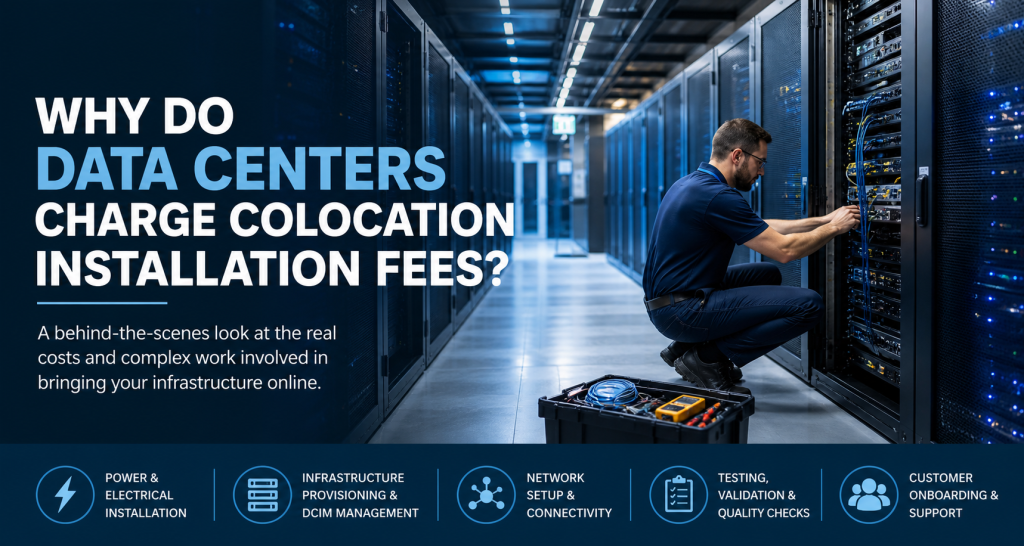
If you have evaluated data center colocation services, you have likely come across a one time installation or setup fee. At first, it may seem like an extra charge, but in reality, it reflects the extensive work required to bring a new customer online inside a professional data center environment.
A modern data center is not plug and play. Every new deployment requires coordination between electrical, network, engineering, and operations teams to ensure reliability, performance, and long term scalability.
Understanding these data center setup costs helps explain why colocation installation fees exist and what they actually cover.
Data Center Electrical Installation Costs
Power is the foundation of every data center deployment. Most data centers do not activate circuits until a new customer is ready to install equipment, which means electrical work often happens on demand.
Licensed electricians, often union labor in major markets, handle this work. In cities like New York, it is not uncommon for a data center to spend two thousand dollars or more just to install redundant 208 volt circuits. That is the direct cost to the facility before any additional configuration or support.
Even existing circuits may need to be modified to meet a customer’s specific voltage, capacity, or outlet requirements.
Data Center Power Provisioning and Configuration
Each data center colocation customer has unique power needs. Some require high density deployments, while others need shared or fractional cabinet space.
Power provisioning in a data center may include dual feeds, specialized outlets, and carefully controlled distribution. For smaller deployments such as quarter cabinets, the same upstream electrical infrastructure is required, so costs must be distributed across a smaller footprint.
Redundant Power and PDU Infrastructure
Reliability is a core promise of any data center. That is why redundant power is standard.
Most colo installations include dual PDUs connected to separate power feeds. These systems must be installed, configured, and tested to ensure proper failover.
In shared data center cabinets, specialized PDU hardware is often required to safely divide power between multiple customers. These systems prevent overload conditions and must be carefully engineered and sometimes custom ordered.
Data centers also maintain spare PDUs on site to ensure rapid replacement in the event of failure.
Data Center Capacity Planning and Cabinet Placement
Before installation, the data center must determine the optimal placement for your equipment.
This involves selecting cabinet space, verifying available power and cooling, and ensuring proper load balancing across the data center floor. Placement decisions are critical to maintaining long term performance and stability.
DCIM Software and Infrastructure Management
Modern data centers rely on DCIM software (Data Center Infrastructure Management) systems, to operate efficiently.
When a new customer is added, their deployment must be fully configured within the data center’s DCIM platform. This includes mapping cabinet space, assigning power circuits, linking PDUs, and tracking usage.
DCIM allows the data center to monitor infrastructure, manage capacity, automate provisioning, and ensure accurate billing. Proper setup within this system is essential for long term reliability and transparency.
Cooling and Heat Management
Adding equipment to a data center impacts airflow and temperature distribution.
Colocation centers continuously analyze heat output and power density to maintain optimal cooling. Engineers may adjust placement or configurations to ensure efficient operation.
Rack Preparation and Cabinet Setup
Before equipment is installed, the data center prepares the cabinet.
This includes cleaning, adjusting rails, installing shelves, providing screws and cage nuts, cable managers, and configuring redundant power distribution units. Each deployment is customized based on the customer’s equipment.
Data Center Network Installation and Cross Connects
Network connectivity in a data center requires both physical and logical setup.
Fiber and copper cross connects must be installed, labeled, tested, and documented. These connections link customers to carriers, internet exchanges, or private networks.
Data Center IP Address Allocation and Network Turn Up
Data center services often include network provisioning.
IP address blocks are allocated, routing is configured, and connectivity is tested. The final turn up process ensures the customer’s environment is fully operational.
Power Testing and Validation
Before deployment, data centers validate power usage to ensure it aligns with the customer’s contracted capacity.
Tools such as power meters are used to measure actual consumption and prevent overload conditions.
Hardware Procurement and Custom Requirements
Some data center customers require specialized hardware or adapters.
For example, certain systems may need video adapters to connect to crash carts for troubleshooting. Data centers must source, track, and inventory these components to support customer environments.
Data Center Monitoring and Remote Management Setup
Data centers configure monitoring and remote access systems for each customer.
This includes assigning power outlets, enabling remote reboot capabilities, and setting up usage tracking for billing and operational visibility.
Billing Configuration and Custom Plans
Colocation pricing in a data center can vary based on power usage, cabinet size, and shared environments.
Billing systems must be configured to reflect the specific agreement and accurately track usage.
Customer Onboarding and Administrative Setup
Onboarding a new customer into a data center involves administrative work such as account creation, portal setup, order processing, and approvals.
These steps ensure a smooth transition into the facility.
Multi Tenant Cabinet Configuration
Shared cabinets within a data center require additional engineering.
Power distribution must be controlled, hardware may be customized, and configurations vary between customers. This adds complexity to both installation and management.
Cleaning, Testing, and Quality Assurance
Before deployment is complete, the data center performs final checks.
This includes cleaning, testing power and connectivity, and verifying that all configurations match the original order.
Why Data Centers Sometimes Waive Installation Fees
Some data centers waive installation fees for longer term contracts.
This allows the provider to recover setup costs over time instead of charging them upfront.
These Installation Fees Reflect Real Costs
Data center colocation installation fees reflect real costs associated with electrical infrastructure, engineering, provisioning, and system configuration. Often times the colocation facilities may be offering a discount from the actual rate, especially in cases like 1/6, 1/4, 1/2 cabinets.
From high cost power circuits and redundant infrastructure to DCIM integration and network turn up, there is significant work required to bring a customer online in a professional data center.
Understanding these factors helps explain pricing and highlights the value of a properly managed data center environment.