
In modern data centers, raw performance is no longer the only metric that matters. Power efficiency has become just as critical, both for operational stability and long-term cost control.
As servers become more powerful, they also draw more energy. But what many customers don’t realize is this:
Maximizing performance settings often increases power consumption far more than it improves real-world performance.
Understanding that trade-off is key to running efficient, scalable infrastructure.
Why our Dedicated Server plans and pricing are based on Power Profiles

At our data center, every server plan is built around a known and tested power profile.
When we deploy hardware, such as Dell PowerEdge R640-R670 nodes, we use standard configurations that allow us to accurately predict:
- Power consumption under load
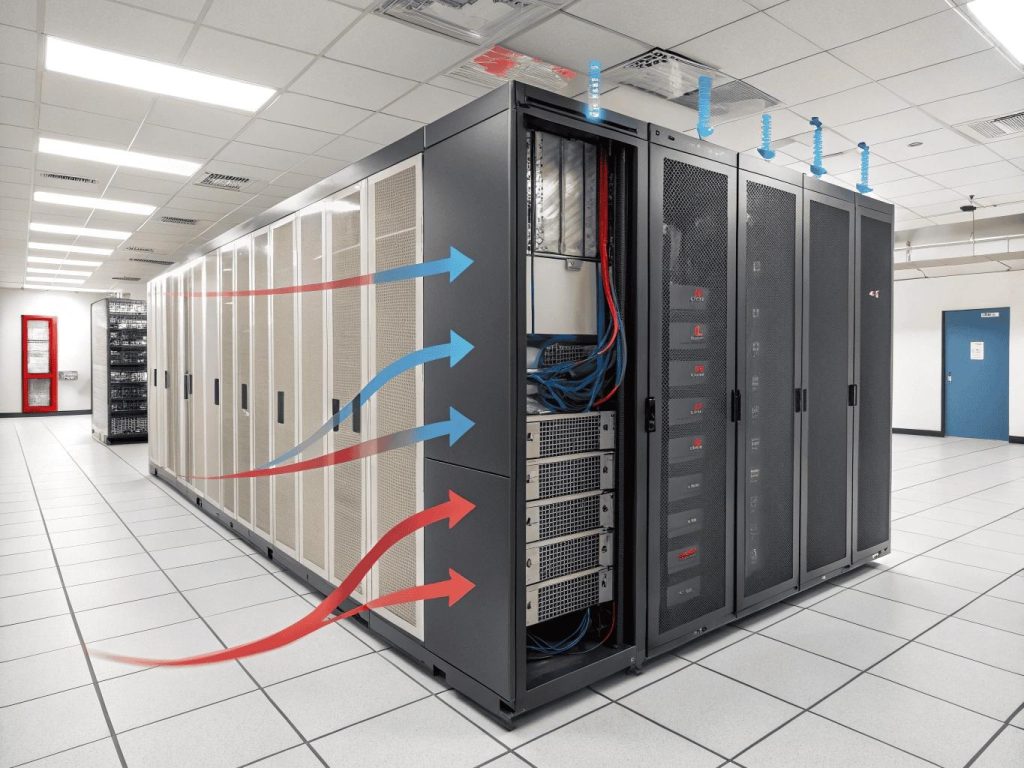
- Cooling requirements
- Rack density and capacity
- Infrastructure utilization
This ensures that every deployment runs reliably within the environment it was designed for.
The Core Principle
Each plan is priced based on the expected energy usage of the hardware in its standard configuration.
What Happens When You Force Maximum Performance
Customers running latency-sensitive or high-performance workloads sometimes request BIOS changes such as:
- Disabling CPU power-saving states (C-states, C1E)
- Setting system profile to “Performance”
- Forcing maximum uncore frequency
- Disabling PCIe power management
- Using maximum performance thermal settings
These changes do exactly what they’re intended to do:
✅ Reduce latency
✅ Increase performance consistency
But also:
⚠️ Increase sustained power consumption
⚠️ Increase heat and fan usage
⚠️ Reduce efficiency
Power usage often rises disproportionately compared to the performance gained.
The “Top 5%” Effect


Modern CPUs like the Intel Xeon Gold 6248R dynamically boost performance when thermal and power headroom is available.
- Base frequency (e.g., 3.0 GHz) is efficient
- Turbo frequencies deliver peak performance—but at much higher power cost
The final 5–10% of performance can consume 20–40% more power.
Why “Clipping the Top 5%” Works
Instead of chasing maximum turbo at all times, many operators choose to limit peak power slightly.
This approach results in:
- Nearly identical real-world performance
- Lower and more predictable power usage
- Reduced thermal stress
- More stable cluster behavior
In some cases, systems even perform more consistently because they avoid thermal or power throttling.
Real-World Cost Example


Let’s put this into practical terms.
In the Northeast U.S., it’s common to see data center power pricing around $500 per kW per month (as of 2026).
Example Scenario:
- 20 servers
- Each averaging ~500 W → 10 kW total load
- Monthly cost → 10 kW × $500 = $5,000/month
Now assume you optimize power usage by just 15% using better BIOS tuning and power caps:
- New load → 8.5 kW
- New monthly cost → $4,250/month
Savings:
$750 per month
$9,000 per year
And that’s with only 20 basic Dell Poweredge servers.
At larger scale, these savings compound quickly, while also reducing cooling demand and extending hardware longevity.
How to Reduce Power Usage (Without Sacrificing Performance)


1. Use Balanced System Profiles
- Performance Per Watt (DAPC)
- Or a custom balanced profile
2. Apply a Power Cap
- Set a system-level wattage limit via iDRAC or BIOS
- Prevent excessive power draw during peak load
3. Avoid “Always Max” Settings
- Disabling C-states
- Forcing max uncore
- Disabling PCIe power management
- Maximum thermal profiles
These should only be used when truly necessary.
Why Small Changes Matter at Scale
Even small reductions add up:
- 50 watts saved per server
- Across 100 servers → 5 kW saved
- Thousands of kWh saved monthly
That translates directly into:
💰 Lower costs
❄️ Less cooling
⚡ More efficient infrastructure
Our Approach
We fully support performance tuning where appropriate—but within a structured framework:
- Our plans are based on standard power profiles
- Infrastructure is provisioned accordingly
- Significant deviations in power usage may require adjustments
This ensures stability, fairness, and long-term sustainability for all deployments.
How do we make this knowledge work for our NYC Colocation customers?
Metanet Hosting take a different approach. As a boutique infrastructure firm with a world class instant provisioning network, trusted by world-class name brands, we don’t just provide space and power, we act as a true partner to your business. Our team works closely with you to optimize performance, reduce power consumption, and improve both CAPEX and OPEX efficiency.
Unlike large REIT-style data center providers (here’s looking at your Equinix, CoreSite, DRT..) that simply deliver power and footprint with close to zero guidance, we actively try help customers make smarter infrastructure decisions. This is why leading companies have chosen Metanet for over 25 years: we function as an extension of your IT team, offering hands-on data center consulting that drives productivity while lowering overall IT spend.
So lets discuss power and cost savings. In general, everyone understands that data centers create a huge energy draw worldwide and everyone is trying to reduce consumption since it profoundly impacts cost. Thus, energy is the elephant in the room when it comes to infrastructure. However, in working closely with numerous small to mid-sized businesses, particularly those heavily dependent on IT or operating within the IT sector, including MSPs and telecom providers, we often find that both technical teams and senior leadership lack awareness of how to effectively reduce costs associated with infrastructure energy consumption. They are often unaware how to measure it, tame it, measure and utilize it inside a data center setting. In these cases, our white glove service creates enormous value, we will offer to audit our customer hardware, and even assign a dedicated Project Manager to help guide optimization efforts and ensure long-term success. This is a value proposition no other data center or telecommunications provider can claim.
The Bottom Line
You don’t need 100% peak performance to get 99% of the results.
By intelligently managing power:
- You maintain performance
- Reduce costs
- Improve stability
- Scale more efficiently
If you’re looking to optimize your deployment, our team is happy to help you strike the right balance between performance and efficiency.