
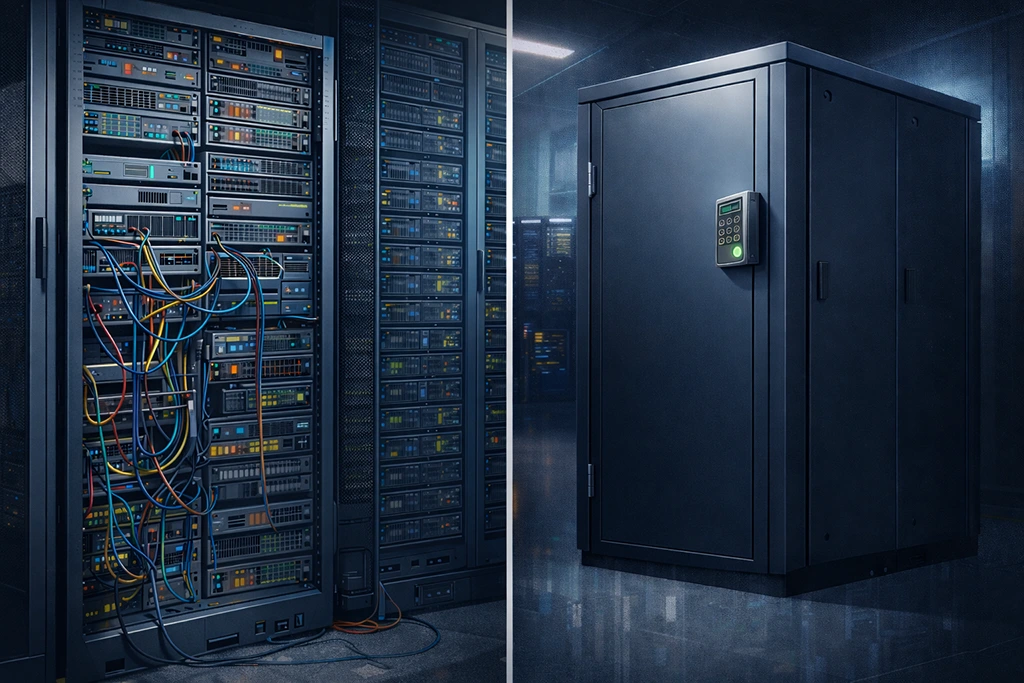
This article discusses the overall limitations of Shared Colocation (which is almost always escorted access), and when it might be time to upgrade to a private locked Quarter Cabinet.
Shared (or “community”) colocation is an excellent starting point for hosting a small number of servers. It’s cost-effective, simple to deploy, and removes much of the operational burden of managing your own infrastructure. However, as workloads grow, shared environments can introduce real performance constraints—particularly around bandwidth.
This article explains how shared colocation networking works, why sustained high bandwidth cannot be guaranteed in shared racks, and when upgrading to a private quarter cabinet becomes the right technical choice.
How Shared Colocation Works
In a shared rack, multiple customers place servers in the same physical cabinet. Network connectivity is delivered through a shared access switch installed at the top of the rack.
Each server may have a 1 Gbps network interface, but those interfaces do not map to individual 1 Gbps paths upstream. Instead:
- Server ports feed into a common access switch
- Traffic from all servers is aggregated on that switch
- The switch connects to the data center core via shared uplinks
This architecture is intentionally designed for statistical usage patterns, where customers use bandwidth intermittently rather than continuously at maximum capacity.
Why Full 1 Gbps Cannot Be Guaranteed in a Shared Rack
The limitation comes down to contention for shared resources.
In a shared rack:
- All tenants draw from the same upstream capacity
- Bandwidth is delivered on a best-effort basis
- Sustained high usage by one server directly affects others
If a single customer were to run a full 1 Gbps continuously, it would consume a disproportionate share of the cabinet’s available uplink capacity and reduce performance for other tenants. To maintain fairness and stability, shared environments are engineered to prevent any one customer from monopolizing the network.
For this reason, data centers cannot technically guarantee sustained, dedicated 1 Gbps performance in a shared rack—even if the server’s network port supports it.
Understanding Bandwidth Options
Bandwidth models reflect how network resources are delivered and isolated.
Unmetered Bandwidth (Shared)
This is the standard offering in shared colocation.
Characteristics:
- Flat monthly rate
- No usage tracking or overage fees
- Best-effort performance
Technical reality:
- Bandwidth is delivered via a shared access switch
- Capacity is pooled across all tenants
- Throughput can vary depending on overall cabinet activity
Unmetered bandwidth works well for customers with 1–2 servers who want simplicity and flexibility without worrying about billing fluctuations.
Burstable Bandwidth (95th Percentile)
Burstable bandwidth is the industry standard for dedicated colocation environments.
How it works:
- You commit to a baseline rate (e.g., 300 Mbps or 500 Mbps)
- Usage is measured continuously
- Billing is based on sustained usage levels
- Traffic above the commit may incur overage charges
Technical requirements:
- A private cabinet
- A dedicated access switch
- Dedicated fiber connectivity
You can burst up to the physical port speed (often 1 Gbps), but only sustained usage above the commit affects billing.
Tiered Bandwidth (Flat-Rate Dedicated)
Tiered bandwidth is burstable bandwidth with the commit set equal to the port speed.
Example:
- 1 Gbps commit on a 1 Gbps port
- Flat monthly rate
- No overages
This model delivers true, sustained 1 Gbps performance because the infrastructure is dedicated and not shared with other tenants.
When Shared Colocation Reaches Its Limits
Shared colocation is no longer the right fit when:
- Applications require sustained high throughput
- Network performance must be predictable
- Traffic patterns are steady rather than bursty
- Customer-facing services depend on consistent latency and speed
At this stage, the constraint is not the server hardware—it’s the shared network design.
Why Upgrade to a Private Quarter Cabinet?
A private quarter cabinet is often the most efficient next step.
What changes:
- Locked, private rack space
- No other customers share your switch
- Dedicated fiber feeding your cabinet
- Guaranteed and scalable bandwidth options
What stays efficient:
- Reasonable cost compared to a full cabinet
- Similar power usage in many cases
- A clear growth path from 1 Gbps to 10 Gbps and beyond
By removing shared network elements, a private quarter cabinet allows the data center to engineer connectivity specifically for your workload.
Final Thoughts
Shared colocation is designed for affordability and flexibility, not guaranteed throughput. Its limitations are architectural, not contractual.
If your workloads demand sustained, predictable bandwidth, the solution is dedicated infrastructure—not larger shared allocations. A private quarter cabinet provides that balance, delivering consistent performance while remaining cost-effective and scalable.
If you’re regularly hitting the limits of a shared rack, it’s a sign of growth—and the right time to move forward.